

How To Calculate Sample Size With Margin Of Error And Confidence Level
Sample Size Calculator

Find Out The Sample Size
This calculator computes the minimum number of necessary samples to meet the desired statistical constraints.
Confidence Level: | ||
| Margin of Error: | ||
| Population Proportion: | Use 50% if not sure | |
| Population Size: | Leave bare if unlimited population size. | |
 | ||
Discover Out the Margin of Error
This calculator gives out the margin of error or conviction interval of ascertainment or survey.
| Confidence Level: | ||
| Sample Size: | ||
| Population Proportion: | ||
| Population Size: | Get out blank if unlimited population size. | |
| | ||
In statistics, information is ofttimes inferred about a population by studying a finite number of individuals from that population, i.e. the population is sampled, and it is causeless that characteristics of the sample are representative of the overall population. For the following, information technology is assumed that in that location is a population of individuals where some proportion, p, of the population is distinguishable from the other ane-p in some style; e.g., p may be the proportion of individuals who have brown hair, while the remaining 1-p have black, blond, ruddy, etc. Thus, to estimate p in the population, a sample of n individuals could be taken from the population, and the sample proportion, p̂, calculated for sampled individuals who take brownish pilus. Unfortunately, unless the full population is sampled, the estimate p̂ most likely won't equal the truthful value p, since p̂ suffers from sampling noise, i.e. information technology depends on the item individuals that were sampled. However, sampling statistics tin can be used to summate what are chosen confidence intervals, which are an indication of how close the approximate p̂ is to the true value p.
Statistics of a Random Sample
The uncertainty in a given random sample (namely that is expected that the proportion estimate, p̂, is a practiced, only not perfect, approximation for the true proportion p) can be summarized past saying that the guess p̂ is normally distributed with hateful p and variance p(one-p)/due north. For an explanation of why the sample estimate is normally distributed, study the Central Limit Theorem. Equally defined below, confidence level, confidence intervals, and sample sizes are all calculated with respect to this sampling distribution. In curt, the conviction interval gives an interval around p in which an judge p̂ is "probable" to be. The confidence level gives just how "likely" this is – due east.g., a 95% confidence level indicates that it is expected that an estimate p̂ lies in the confidence interval for 95% of the random samples that could be taken. The confidence interval depends on the sample size, n (the variance of the sample distribution is inversely proportional to n, pregnant that the gauge gets closer to the truthful proportion as n increases); thus, an acceptable error rate in the estimate can besides exist set, called the margin of error, ε, and solved for the sample size required for the chosen confidence interval to exist smaller than eastward; a calculation known as "sample size calculation."
Confidence Level
The confidence level is a mensurate of certainty regarding how accurately a sample reflects the population being studied within a called conviction interval. The most commonly used confidence levels are ninety%, 95%, and 99%, which each have their own corresponding z-scores (which can be found using an equation or widely bachelor tables like the one provided below) based on the called confidence level. Annotation that using z-scores assumes that the sampling distribution is normally distributed, equally described above in "Statistics of a Random Sample." Given that an experiment or survey is repeated many times, the confidence level essentially indicates the percentage of the time that the resulting interval establish from repeated tests volition contain the truthful upshot.
| Conviction Level | z-score (±) |
| 0.70 | 1.04 |
| 0.75 | i.fifteen |
| 0.80 | ane.28 |
| 0.85 | 1.44 |
| 0.92 | ane.75 |
| 0.95 | 1.96 |
| 0.96 | 2.05 |
| 0.98 | 2.33 |
| 0.99 | 2.58 |
| 0.999 | 3.29 |
| 0.9999 | 3.89 |
| 0.99999 | 4.42 |
Confidence Interval
In statistics, a confidence interval is an estimated range of likely values for a population parameter, for example, 40 ± ii or 40 ± 5%. Taking the usually used 95% confidence level as an example, if the same population were sampled multiple times, and interval estimates made on each occasion, in approximately 95% of the cases, the true population parameter would be independent within the interval. Note that the 95% probability refers to the reliability of the interpretation process and non to a specific interval. Once an interval is calculated, it either contains or does not contain the population parameter of interest. Some factors that affect the width of a confidence interval include: size of the sample, conviction level, and variability inside the sample.
At that place are different equations that can exist used to calculate confidence intervals depending on factors such equally whether the standard difference is known or smaller samples (north<30) are involved, amidst others. The reckoner provided on this page calculates the confidence interval for a proportion and uses the following equations:
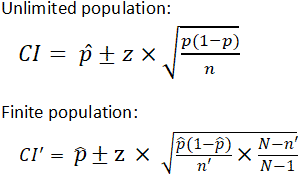
z is z score
p̂ is the population proportion
northward and n' are sample size
N is the population size
Within statistics, a population is a set of events or elements that have some relevance regarding a given question or experiment. It can refer to an existing group of objects, systems, or even a hypothetical group of objects. Near commonly, however, population is used to refer to a grouping of people, whether they are the number of employees in a company, number of people within a certain age group of some geographic area, or number of students in a academy's library at any given time.
It is important to notation that the equation needs to be adjusted when considering a finite population, as shown above. The (N-n)/(N-i) term in the finite population equation is referred to every bit the finite population correction factor, and is necessary because it cannot be assumed that all individuals in a sample are contained. For example, if the study population involves 10 people in a room with ages ranging from i to 100, and ane of those called has an age of 100, the next person called is more likely to accept a lower age. The finite population correction factor accounts for factors such as these. Refer below for an example of calculating a confidence interval with an unlimited population.
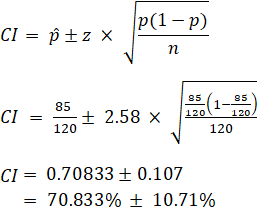
EX: Given that 120 people piece of work at Company Q, 85 of which drink coffee daily, find the 99% confidence interval of the true proportion of people who drink coffee at Company Q on a daily basis.
Sample Size Adding
Sample size is a statistical concept that involves determining the number of observations or replicates (the repetition of an experimental condition used to estimate the variability of a miracle) that should be included in a statistical sample. It is an important aspect of any empirical study requiring that inferences be fabricated about a population based on a sample. Essentially, sample sizes are used to represent parts of a population chosen for whatever given survey or experiment. To comport out this calculation, gear up the margin of mistake, ε, or the maximum distance desired for the sample approximate to deviate from the true value. To do this, use the confidence interval equation above, but set the term to the right of the ± sign equal to the margin of error, and solve for the resulting equation for sample size, n. The equation for calculating sample size is shown beneath.
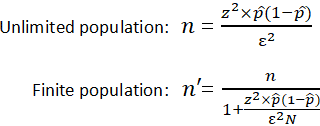
z is the z score
ε is the margin of error
N is the population size
p̂ is the population proportion
EX: Decide the sample size necessary to gauge the proportion of people shopping at a supermarket in the U.South. that identify as vegan with 95% conviction, and a margin of fault of 5%. Presume a population proportion of 0.5, and unlimited population size. Remember that z for a 95% confidence level is one.96. Refer to the table provided in the conviction level section for z scores of a range of confidence levels.
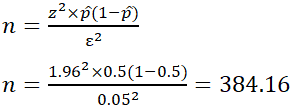
Thus, for the case in a higher place, a sample size of at least 385 people would be necessary. In the above example, some studies estimate that approximately 6% of the U.S. population place as vegan, so rather than assuming 0.5 for p̂, 0.06 would be used. If it was known that xl out of 500 people that entered a detail supermarket on a given twenty-four hours were vegan, p̂ would then exist 0.08.

How To Calculate Sample Size With Margin Of Error And Confidence Level,
Source: https://www.calculator.net/sample-size-calculator.html
Posted by: greenguaraction.blogspot.com
0 Response to "How To Calculate Sample Size With Margin Of Error And Confidence Level"
Post a Comment